Best Vocal Rider Plugin in 2026: 10 Plugins Compared (Waves, WaveRider, DynaRide & More)
If you've ever spent hours drawing vocal automation curves by hand, you already understand why vocal rider plugins have become essential tools in modern music production.
A great vocal performance rarely stays at a perfectly consistent level. Some phrases disappear into the mix while others jump out unexpectedly. Traditionally, engineers solved this problem through manual automation or heavy compression. Both methods work. Neither is ideal.
Manual automation is time-consuming. Heavy compression can alter the natural dynamics and emotion of a performance. That's where auto gain plugins come in.
By automatically adjusting gain in real time, these tools help producers achieve more consistent vocal levels while preserving the character of the original performance.
But with options ranging from Waves Vocal Rider and WaveRider to newer independent alternatives, which vocal rider plugin is actually worth using in 2026?
After comparing the most popular solutions on the market, here's what producers need to know.
Editor's Picks
🥇 Best Overall Vocal Rider: RaiderPro
🥈 Best Premium Solution: WaveRider
🥉 Best Free Leveler: VOLA
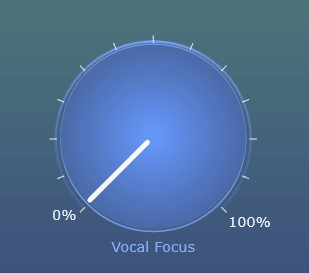
🏆 Best One-Knob Vocal Leveler: Vocal Focus
🏆 Best Complete Dynamics Suite: RPro2
What Is a Vocal Rider Plugin?
A vocal level plugin automatically adjusts vocal gain in real time.
Unlike a compressor, which reduces dynamic range, a vocal level automation plugin behaves more like an engineer moving a volume fader throughout a performance.
The result is:
- More consistent vocal levels
- Better intelligibility
- Less manual automation
- Faster mixing workflows
- Reduced reliance on aggressive compression
Most professional engineers place a Vocal level automation before compression, creating a more consistent signal that allows compressors to work more transparently.
Vocal Rider vs Compression: What's the Difference?
Many producers assume an auto vocal leveler is simply another compressor. It isn't.
Compression
A compressor reduces the difference between loud and quiet sounds.
Benefits:
- Controls peaks
- Adds character
- Increases perceived loudness
Potential drawbacks:
- Can flatten performances
- May introduce pumping artifacts
- Alters transient behavior
Vocal Riding
A vocal leveler adjusts gain before compression occurs.
Benefits:
- Preserves natural dynamics
- Reduces manual automation
- Improves compressor performance
- Maintains vocal clarity
For most professional vocal chains, riding and compression work together rather than replacing one another.
Why Producers Are Moving Beyond Traditional Vocal Volume Automation Solutions
For more than a decade, Waves Vocal Rider has been one of the most recognized names in automatic vocal leveling. It remains a capable tool today. However, producer expectations have changed.
Across audio production communities, users increasingly mention concerns such as:
- Subscription fatigue
- Ecosystem lock-in
- Activation managers
- Upgrade plans
- Large installation systems
- Paying repeatedly for software they already own
Many producers now prefer software that offers:
- Lifetime ownership
- Simple installation
- Socially responsible companies
- Direct support from developers
- Transparent pricing
This shift has created opportunities for newer vocal riding solutions designed around modern workflows.
Best Vocal Leveler Plugins Compared
| Plugin | Approx. Price | Best For |
|---|---|---|
| RaiderPro | $34.99 | Best Overall Alternative |
| Vocal Focus | $17 | Fastest Workflow |
| RPro2 | $49 (limited time) | Complete Dynamics Suite |
| Waves Vocal Rider | $34.99 | Legacy industry standard |
| WaveRider | ~$199 | Advanced automation workflows |
| DynaRide | ~$44 | Technical users requiring deep control |
| VOLA | Free | Voice leveling and broadcast work |
| Outlaw Lite | Free | Beginners exploring gain riding |
| HoRNet AutoGain | ~€12 | Sidechain-based automatic gain curve creation |
| R-Vox | $39.90 | Grammy-winning vocal compression, 3-knob simplicity |
 Waves Vocal Rider
Waves Vocal Rider helped popularize automatic vocal gain riding and remains one of the most recognizable tools in the category.
Pros
- Proven workflow
- Low CPU usage
- Real-time gain riding
- Automation support
- Widely adopted
Cons
- Aging interface
- Ecosystem dependency
- Pricing fluctuations
- Less innovation compared to newer alternatives
Best For
Engineers already invested in the Waves ecosystem who want a familiar workflow.
 RaiderPro
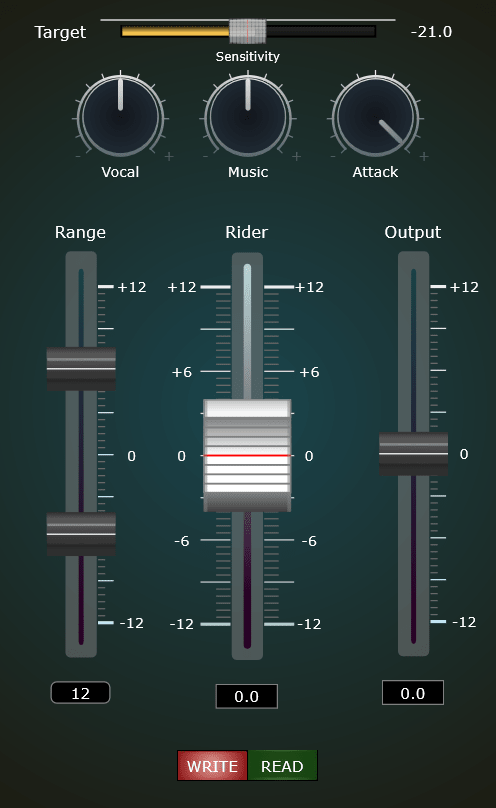
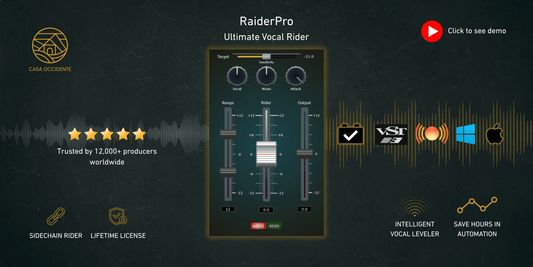
While I was researching the Vocal Rider market and analyzing feedback from producers, engineers, and content creators, one trend appeared repeatedly. Many users liked the concept of Waves Vocal Rider but wanted modern compatibility, simpler ownership, and a more streamlined workflow.
I developed RaiderPro specifically to address those needs. What makes this tool special is its origen, RaiderPro was built by me, Diego Ortega, an independent DSP developer and active music producer focused on solving real-world vocal leveling challenges.
Pros
- Real-time gain riding
- Transparent vocal leveling
- Lifetime license
- Modern plugin formats (VST3, AU)
- Fast workflow
- Personal support
- Constant updates
- Less CPU usage
Cons
- Smaller ecosystem than larger software companies
- Newer product compared to legacy competitors
Best For
Producers seeking a modern alternative to Waves Vocal Rider with perpetual ownership and streamlined workflows.
Try RaiderPro Free →
https://casaoccidente.com/products/raiderpro-free-trial
Buy RaiderPro →
https://casaoccidente.com/products/rider-pro-plugin
 Vocal Focus
Not every producer wants dozens of controls. Some simply want consistent vocal levels as quickly as possible. Vocal Focus was designed around that philosophy.
Pros
- One-knob operation
- Extremely fast setup
- Beginner-friendly
- Great for podcasts and content creation
- Lifetime ownership
- Less CPU usage
Cons
- Less control than dedicated rider plugins
Best For
Users who prioritize simplicity and speed above all else.
Buy Vocal Focus →
https://casaoccidente.com/products/vocal-focus-vocal-rider-plugin
 RPro2
RPro2
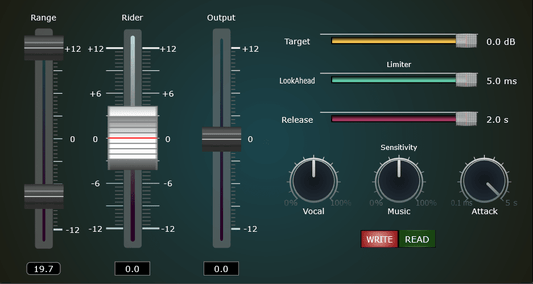
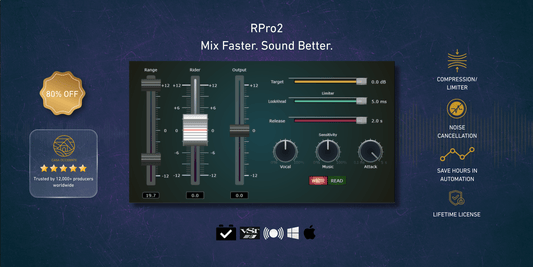
While most vocal riders focus exclusively on gain automation, RPro2 takes a broader approach. It combines automatic gain riding, compression, limiting, and sidechain processing inside a single plugin. Rather than acting solely as a vocal leveler, it serves as a complete dynamics-processing environment.
Pros
- Multiple processors in one plugin
- Consolidates workflow
- Reduces plugin count
- Lifetime license
- Suitable for vocals, buses, and full mixes
- Less CPU usage
Cons
- More functionality than users may need if they only want vocal riding
Best For
Producers seeking an integrated dynamics-processing workflow.
Try RPro2 Free →
https://casaoccidente.com/products/rpro2-ultimate-dynamics-free-trial
Buy RPro2 →
https://casaoccidente.com/products/rpro2-limiter-rider-automation-perpetual-license
 WaveRider
WaveRider is one of the most feature-rich vocal riding solutions available today.
Pros
- Deep automation capabilities
- Dynamics tracing
- Ducking modes
- Advanced workflow options
Cons
- Expensive
- Steeper learning curve
Best For
Professional engineers who need maximum automation control and are comfortable with premium pricing.
 DynaRide
DynaRide focuses on detailed control and customization.
Pros
- Adjustable response behavior
- Sidechain support
- Voice-specific processing
- Advanced parameter control
Cons
- More complex workflow
- Less beginner-friendly
Best For
Engineers who prefer extensive customization over simplicity.
 VOLA 2
VOLA is one of the most widely discussed free vocal leveling plugins.
Pros
- Free
- Easy to use
- Good for dialogue and spoken-word content
Cons
- More limited than premium alternatives
- Less flexible than dedicated vocal levelers
Best For
Users looking for a free introduction to automatic vocal leveling.
 Outlaw Lite
Outlaw Lite offers a straightforward introduction to gain riding.
Pros
- Free
- Beginner-friendly
- Helpful visual feedback
Cons
- Limited feature set
- Often outgrown by advanced users
Best For
New producers exploring vocal leveling for the first time.
 HoRNet AutoGain
HoRNet AutoGain was designed with a specific purpose: drastically reducing the time needed to create gain automation curves.
Pros
- Automatic gain adjustment via sidechain reference
- Adjustable reaction speed
- Adjustable reference sensitivity
- Configurable gain adjustment range
Cons
- Requires a sidechain-capable DAW setup
- Less focused on vocal riding specifically
Best For
Producers who want to automate gain relative to a reference track or mix bus, with minimal manual curve drawing.
 R-Vox
R-Vox
Acclaimed by Drake's producer Noah "40" Shebib as "one of the most important vocal plugins ever created".
Pros
- Optimized compression for vocals, voiceover, and podcasts
- Simple yet highly effective: 3 controls do the work
- Light, dark, or classic appearance options
Cons
- Limited control for engineers who prefer deep parameter customization
- Part of the Waves ecosystem (subscription or perpetual license required)
Best For
Producers who want minimal setup — ideal for vocals, voiceover, and podcasting.
What Makes a Great Vocal Leveler Plugin?
After studying competing products, producer feedback, and real-world workflows, the best vocal leveler plugins typically share several characteristics:
Transparent Gain Riding
The processing should remain inaudible.
Adjustable Response Speed
Different performances require different riding behavior.
Real-Time Operation
No rendering or offline processing required.
Reliability
The plugin should perform consistently during critical sessions.
Broad Compatibility
Support for major DAWs and plugin formats.
Strong Value
Most producers want professional results without premium pricing.
Perpetual Ownership
Increasingly, users prefer paying once and owning their software permanently.
Which Vocal Leveler Plugin Should You Choose?
Choose RaiderPro if: you want a modern Waves Vocal Rider alternative with perpetual licensing and streamlined installation.
Choose Vocal Focus if: you want the fastest possible workflow.
Choose RPro2 if: you want gain riding plus compression, limiting, and sidechain processing in one plugin.
Choose Waves Vocal Rider if: you already use Waves products extensively or want the established industry-standard workflow.
Choose WaveRider if: you need advanced automation features and budget is not a major concern.
Choose DynaRide if: you prefer deep parameter-level control.
Choose VOLA or Outlaw Lite if: you want a free solution.
Choose HoRNet AutoGain if: you want to automate gain relative to a reference track or mix bus, prefer a sidechain-driven approach.
Choose R-Vox if: you want vocal compression with minimal setup and a simple 3-knob interface.
Frequently Asked Questions
What is the best vocal leveler plugin?
The best vocal leveler depends on your workflow. Many engineers continue using Waves Vocal Rider, while newer alternatives such as RaiderPro focus on modern compatibility and perpetual ownership.
Is a vocal leveler better than a compressor?
No. They solve different problems. A vocal leveler adjusts gain before compression, while a compressor controls dynamic range.
What is the best free vocal rider plugin?
VOLA and Outlaw Lite are among the most popular free options currently available.
What is the best alternative to Waves Vocal Rider?
Producers looking for perpetual licensing and modern workflows often consider RaiderPro as an alternative to Waves Vocal Rider.
Can vocal rider plugins be used on podcasts?
Absolutely. Many podcast editors use vocal riders to reduce manual volume automation and improve consistency.
Should a vocal rider come before or after compression?
In most workflows, vocal riders are placed before compressors to provide a more consistent signal for downstream processing.
Final Verdict
For producers seeking modern workflows, perpetual ownership, streamlined installation, and strong value, RaiderPro and Vocal Focus have become increasingly attractive alternatives.
Waves Vocal Rider remains one of the most recognized vocal riding tools available. WaveRider offers unmatched automation depth. DynaRide appeals to technical users, while VOLA and Outlaw Lite provide excellent free entry points. HoRNet AutoGain stands out as a budget-friendly option for producers. R-Vox brings simplicity to vocal compression.
And for users who want to move beyond standalone vocal riding entirely, RPro2 offers a complete dynamics-processing solution in a single plugin.
The goal of a vocal rider isn't simply saving time. It's allowing you to spend less time drawing automation curves and more time making music.
Ready to Spend Less Time Automating Vocals?
Whether you're looking for a direct alternative to Waves Vocal Rider, a one-knob vocal leveling solution, or a complete dynamics suite, Casa Occidente offers workflows designed around modern producers—not subscriptions.
Explore RaiderPro, Vocal Focus, or RPro2 and discover which approach best fits your production style.